For successful families planning ahead

Your wealth is your plan. Is that enough?

Many families assume they can self-fund long-term care. Few have stress-tested what a 6–10+ year care event — or care for both spouses — would do to their wealth after inflation, taxes, and potential market downturns.

The numbers most families haven't run
6–10+
Years of possible care with cognitive decline
$2M+
Possible lifetime care cost
150x+
More likely to face extended care than lose your home to fire — yet everyone insures the latter

"Wealthy people understand leverage, risk management, and using other people's balance sheets. Long-term care planning is no different."

— The wiseLTCplanning approach
A personal perspective

Two families. Two very different outcomes.

As a loving son, I carry some guilt about my parents' situation. I knew the risks. I understood the numbers. And I didn't push hard enough. Now I am watching them navigate a long-term care journey without the comfort of insurance as part of their plan — facing an uncertain future that could have looked very different.

My 91-year-old neighbor did plan. His wife has required 24/7 care at home for over 10 years. Because of that policy, he's been able to give her the best possible care — without sacrificing his own health, his emotional wellbeing, or the wealth they spent a lifetime building.

One decision made years earlier. Two completely different outcomes. Watch the video to hear the full story.

❌ Without insurance

Financial pressure, limited options, family stress — even with substantial assets.

✓ With Strong LTC Insurance

10+ years of 24/7 home care. Wealth protected. Family protected. No regrets.

A personal story about why this planning matters — and why most families wait too long.
3 Mindset Shifts

Most families are thinking about this wrong

These three short videos explain the financial realities behind wiseLTCplanning. Watching them in order reveals why the risk isn't just about healthcare — it's about what an extended care event does to a portfolio.

1. It's Not the Event — It's the Duration

The greatest financial risk is often not that care happens, but how long it lasts.

Takeaway: The real financial risk of long-term care is duration.
2. The Self-Funding Challenge

Paying for care from investments may require larger withdrawals than most families expect.

Takeaway: Taxes, inflation, and time can quietly magnify the cost.
3. Transferring the Catastrophic Risk

Many advisors view long-term care as a risk-transfer problem, not just a savings problem.

Takeaway: Thoughtful planning protects against the longest, most devastating scenarios.
The Power of One Decision

Same family. Same care event. A $1.9M portfolio swing — and lifetime coverage still in place for both spouses.

The numbers below show what happens when one couple plans ahead and transfers some of the risk — instead of shouldering it all and hoping for the best.

Starting Portfolio $3,000,000
Annual Care Cost $240,000
LTC Insurance None
Care Inflation / Tax Rate / Return 5.5% / 35% / 6%
Total Care Cost
$3,090,085
Gross Withdrawals
$4,753,977
Unpaid Care Cost
$659,044
Portfolio Exhausted
Year 9
Portfolio Remaining Total Cost of Care
✗ Portfolio exhausted in Year 9. $659,044 in care costs left with no funding source.

When the money runs out in Year 9 — then what?

  • Care doesn't stop. Who covers the bills — and for how long?
  • Does the burden fall on adult children? What does that cost them financially and professionally?
  • If the other spouse is still alive, where does their financial security come from?
  • What if the surviving spouse also needs care — with nothing left in the portfolio?
These are the questions a funded plan answers before they become a crisis.
The portfolio swing from one planning decision
$1,899,286
From $659,044 in unpaid care costs to $1,240,242 still in the portfolio — same care event, same family, some of the risk transferred.
Get in Touch →

Simplified illustration. Does not model market volatility. LTC benefit amount, premium, and portfolio assumptions are illustrative. Individual results will vary based on age, health, policy design, and carrier.

Run Your Own Scenario

What do your numbers look like?

The scenarios above use illustrative assumptions. Our interactive calculator lets you plug in your own portfolio size, investment return, tax rate, care cost and length — and even introduce the effect of LTC insurance to see how it changes the outcome.

Enter your portfolio value
Your number
Not the example $3M
Drag the LTC slider
$0 – $20K/mo
See the impact instantly
Simulate a market shock
−18.3% Yr 1
See how timing changes everything
Run My Own Numbers → Takes about 60 seconds. No signup required.
A smarter approach

Why smart money transfers this risk — instead of absorbing it

Wealthy families use leverage, risk transfer, and other people's balance sheets every day — in real estate, business, and investing. Long-term care is no different.

Self-funding a long care event means deploying your own capital — often at the worst possible time, during market volatility, with the highest tax burden, with no upside. That's not a strategy. That's an unhedged exposure.

The smart approach is to transfer some of the unquantifiable risk onto the balance sheet of the insurance company. A relatively modest reallocation today can protect a far larger portion of your wealth from the unpredictable cost of an extended care event.

Self-Funding vs. LTC Insurance

Self-Funding LTC Insurance
Cost of care Paid from your portfolio Paid by the insurer
Tax impact Most withdrawals subject to income tax Benefits received tax-free
Market risk Withdrawals during downturns accelerate depletion Zero — insurer pays regardless
Duration risk Longer care = faster portfolio exhaustion Coverage guaranteed for life
If care never needed Investments grow as planned Death benefit to heirs + potential cash value
Spouse protection Second care event compounds the damage Both spouses covered under one policy
The bottom line: Self-funding long-term care means bearing 100% of an unquantifiable risk with your own portfolio — paying taxes on every withdrawal, with no protection against market timing, duration, or a second care event. LTC insurance transfers that risk to an insurer's balance sheet, keeps care costs tax-free, and ensures value exists whether care is needed or not. That's the kind of risk management successful families apply everywhere else in their financial lives.
Personalized projection

See your potential long-term care path

This short projection uses real healthcare and longevity data to estimate:

  • When care may begin
  • How long it could last
  • What it may cost in your area
See My Potential Care Path →

Takes about 3 minutes. Uses real healthcare and longevity data.

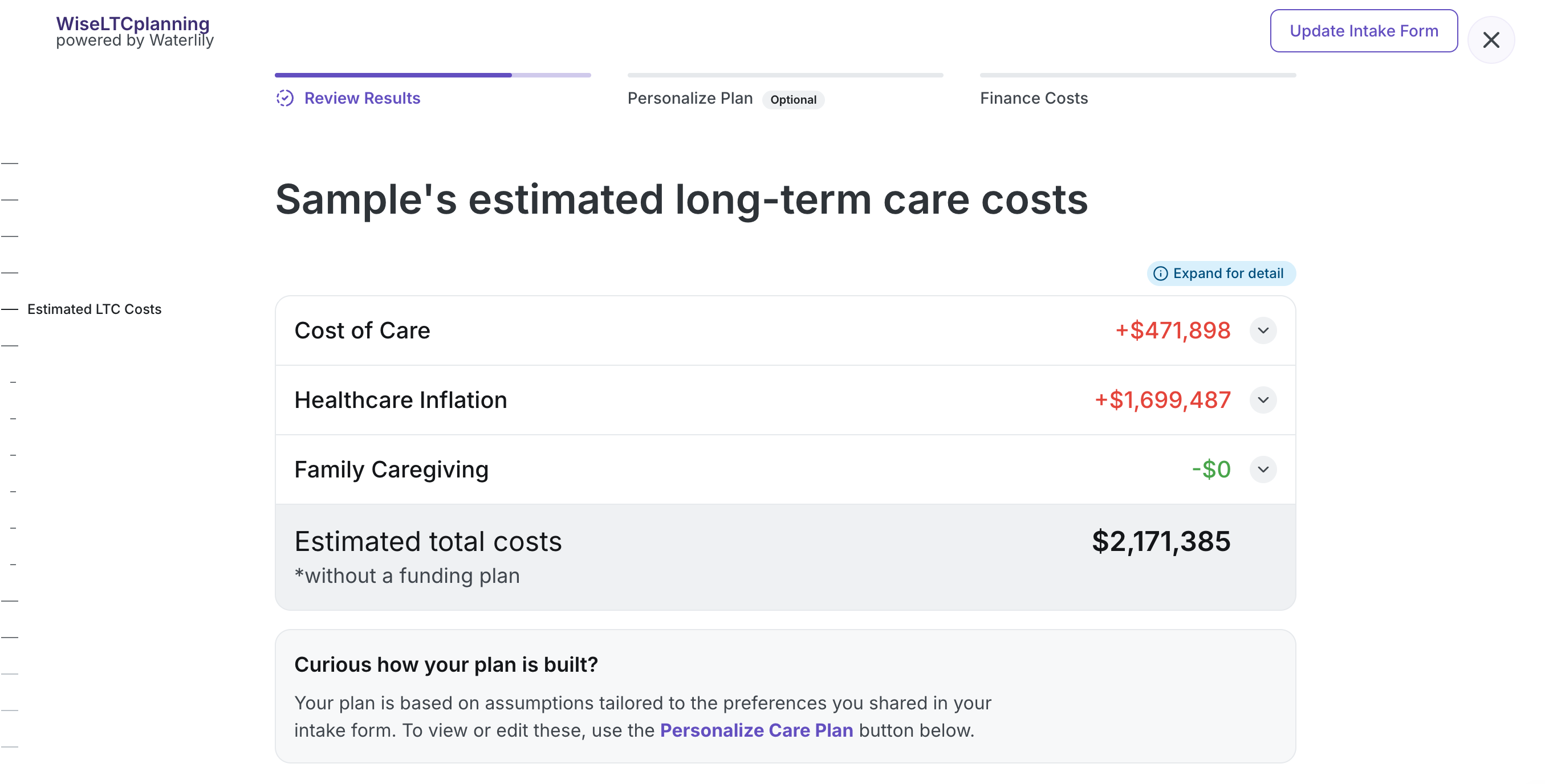
Sample output

Sample Waterlily long-term care cost projection showing $1,749,802 in estimated total costs

A real sample output — personalized to age, health, location, and family situation. Most families are surprised by the numbers.

Educational guide

The 7 Silent Wealth Killers of Long-Term Care

A concise guide for affluent families — covering the hidden financial, tax, and family-dynamic risks that most long-term care conversations overlook.

Your next step

Have a question? Let's talk.

In about 30 minutes, we typically cover:

  • Your potential long-term care exposure
  • The real after-tax cost of self-funding care
  • How LTC insurance compares to what you already have
  • Specific options, structures, and what they actually cost

No obligation, no product push. Just a genuine conversation about your situation.

Reach out directly — email, text, or call. Any of those works.